QR CODE VS RFID:
what these technologies are for
and which one to choose.
In the era of digital and connectivity, the new technologies play a crucial role in the external world, directly influencing the field of traceability, identification, and automation. Two of these technologies, QR codes and RFID chips, are the most well-known and used in this field. Although both are developed with the aim to ease the interaction, they run differently and present significant differences in their functionalities, applications and benefits.
So, it is fundamental to understand completely these two technologies to be able to choose the most suitable option for the different needs. First of all, let’s understand what a QR code and RFID are.
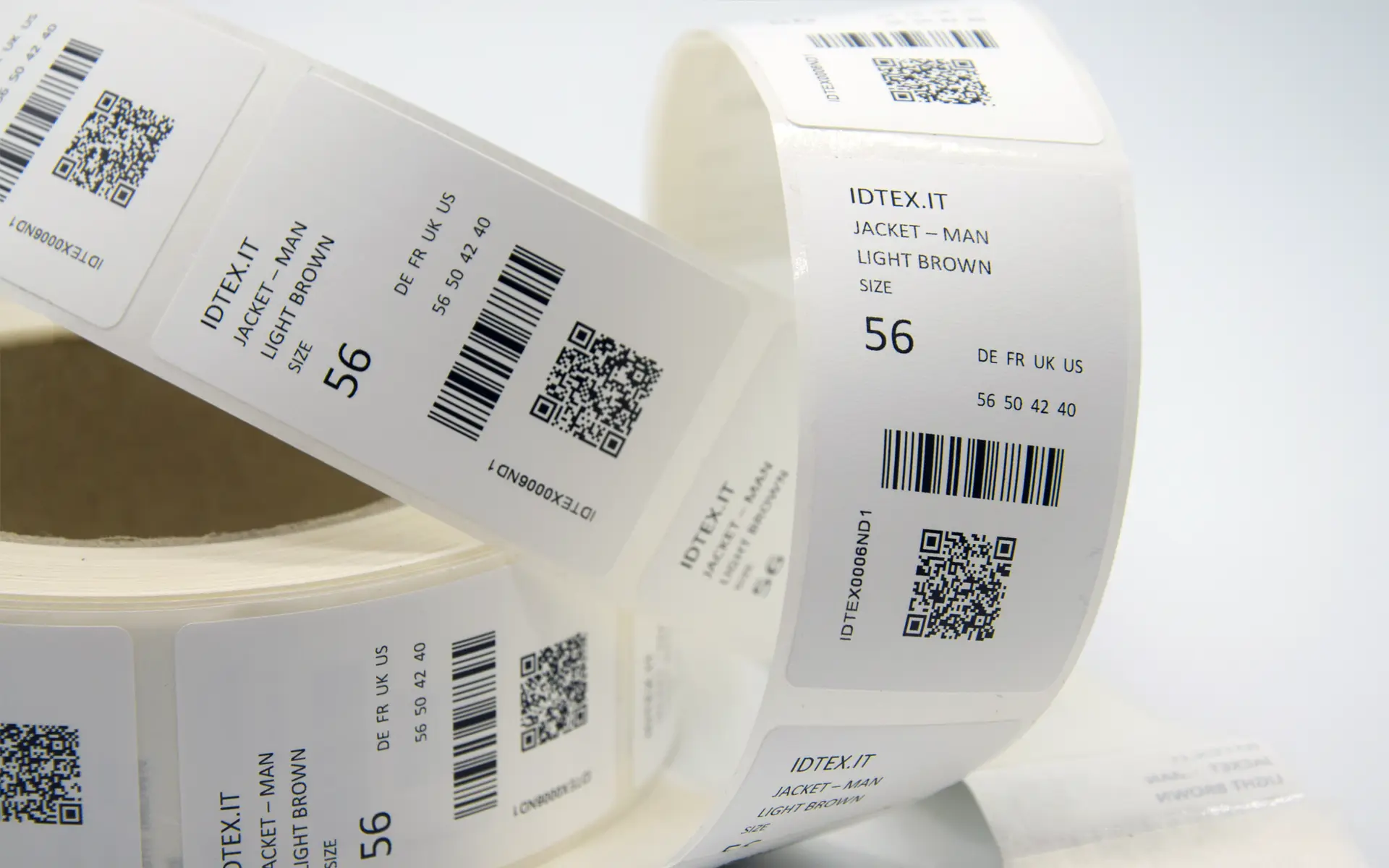
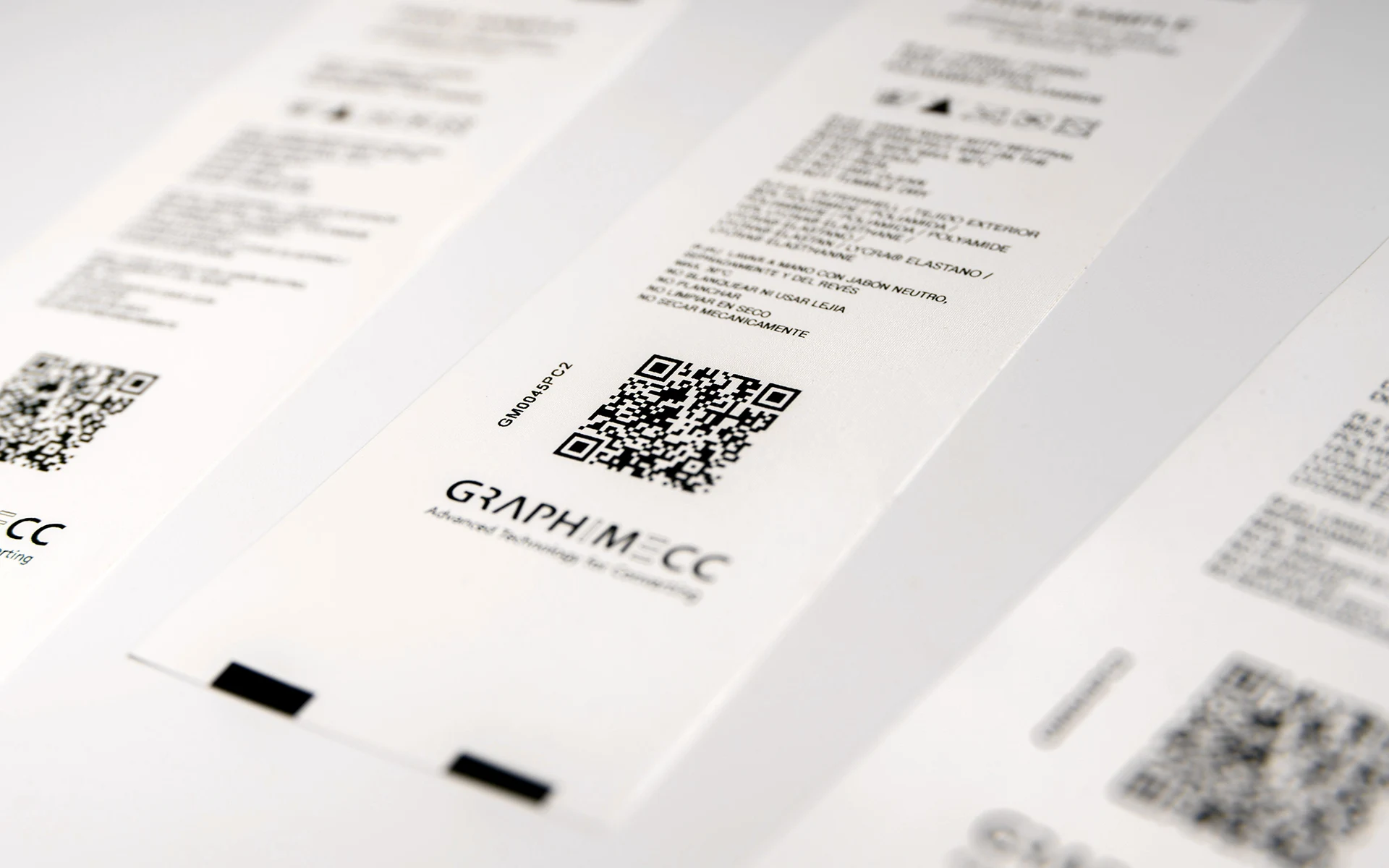
A QR code (Quick Response Code) is a type of bidimensional barcode containing information which are readable by a barcode scanner. Generally, the QR code addresses the user to a specific URL, chosen by the barcode creator or it memorizes information and data sequences that are unique and associable to a product.
A RFID (Radio Frequency Identification) is a type of wireless technology that uses radio waves to identify and track objects by positioning a RFID chip on the items. It allows to identify and track objects contactless and without line of sight, even at long distances, representing a huge advantage for many companies.
9 main differences between QR CODE and RFID
After understanding that these tools have different mechanisms and run in different scenarios, we will go into detail to show the main differences between these two.
Morphology
QR Code The QR code is characterized by a picture (digital or physical) scannable through the optical reading of adequate devices as the smartphone.
RFID The RFID is a physical element, characterized by a supporting substrate (generally in PET), an aluminum antenna and a microchip, scannable through more expensive and innovative tools.
Accessibility
QR Code The QR code is individually scanned, one code at time, so, not allowing a simultaneous reading. Today is largely widespread and used to ease the interactions.
RFID The RFID is a safe system that allows the access only to permitted tags. It can be scanned in blocks in a short time, allowing the reading of several information simultaneously.
Information editing
QR Code The QR code (physical or digital picture) enables read-only information and, once it is created, it is not possible to edit the URL or the information contained. In the case of URL, the only way to edit the content to show to the one who scans the QR code is represented by the editing of the final webpage.
RFID The RFID, in addition to read the information, allows their update through suitable devices to the different ranges of RFID available on the market.
Reading Mode
QR Code The QR code is red through visive contact, in proximity of a device, generally by a camera that has to focus a picture.
RFID An RFID is red through a radio signal transmitted by a device suitable for reading RFID tags. This reading distance can range from a few centimeters to more than 10 meters and depending on the different RFID frequencies, there are different RFID readers to read any tag.
Uniqueness
QR Code Basing on the information to encode inside the code, it is possible to create endless QR codes.
RFID The RFID is non duplicable and has a unique factory number that identifies it.
Traceability
QR Code The QR code is static and the information are sent just when are scanned manually.
RFID The RFID can be tracked and provide information in real time, automatically and easily
Interference
QR Code In the case of QR code, the interference could be characterized by a simple physical obstacle, QR code defects or by the clear contrast between the background and the QR code (in fact, the QR code runs adequately only if the background is white and the QR code is black).
RFID For the RFID, the interference can depend on the type of frequency used, for example liquids and metals can have a strong influence on the reading of high frequency RFID tag (UHF).
Fragility
QR Code The QR code appears to be more compact, the only issues are about physical defects, some dirt that can prevent it from being scanned or codes that are too small.
RFID The RFID is more fragile and if it is not protected adequately can break in different ways, both due to mechanical stress (physical breaking of the chip that can happen for a push or cut of the chip) and electrostatic charges.
Cost
QR Code A digital QR code is free of charge, a physical QR code is a quite cheap and easy choice to implement with the right partner.
RFID The RFID provides several benefits and, for this reason, is very expensive and its cost changes considerably basing on the specific RFID of reference.
QR Code and RFID applications:
The QR codes and the RFID represent powerful tools for a wide range of fields. Both are suitable for specific sectors due to their peculiarities, and both provide high added value solutions. In the following paragraph, we will describe in detail the main applications for each technology:
QR CODE applications:
Product identification, above all in the food and fashion industry. Every product can be equipped with a unique code that allows the customers to access to detailed product information.
In the marketing and communication field, on advertising posters, promotional initiatives, catalogues, and brochures. They enable consumers to quickly access information, digital contents, exclusive discounts, explainer videos and much more.
In the healthcare industry to facilitate the access to medical information of every single patient.
In the education and art field, it provides interactive information to engage the customers, enhancing the experiences.
RFID applications:
In the logistic and production industry, to trace the goods throughout the supply chain in real time, enhancing the efficiency and decreasing the mistakes.
In the manufacturing and industrial sector, to trace raw materials and finished products, making easier the inventory and warehouse management, reducing the times.
In the field of the authenticity verification (anti-counterfeiting and fight against gray markets)
In the security industry, to monitor the accesses inside structures or in some event.
So, it can be affirmed that QR and RFID applications can provide many advantages in several fields, creating innovative solutions for any need.
How to implement these technologies?
Once understood all the variables of these two technologies, it is essential to choose the most appropriate according to the need and involve the right partner to implement them successfully.
Over twenty years, Graphimecc and its team of experts deal with this, supporting its customers in the decision-making process to identify the most adequate technology for their specific needs. Thanks to its machineries or via productive support, Graphimecc allows the label, packaging converters and paper transformation industry to apply these technologies with the highest qualitative standards, reducing to minimum the potential risks resulting from the choice between QR code and RFID.
Contact us
Let us begin this conversation
Contact us
Let us begin this conversation
CIJ Inkjet printers
Non-conforming product marking or reconciliation
We integrate Videojet 1280/ VJ1580+
The unit has been fully integrated into the machine control panel what enables a wide range of benefits
For the operator: Possibility of having a single panel where every machining parameter can be configured
For net plant productivity: Reduction of setup time and guarantee of constant and correct functioning of the unit
Non-conforming Product Marking Functionality
The machine process automatically handles the marking of non-conforming products by integrating it within the error management process chosen for production.
Functionality of printing on the back of the material
The machine process automatically manages the printing of variable data on the back of the material (liner) for each reconciliation requirement by integrating their management within the error management process chosen for production.
Ability to integrate other third-party CIJ systems
Other third-party CIJ printing systems can be integrated upon development of the command-and-control interface.
TTO Printer
Thermal transfer printing
We integrate Videojet Dataflex 6530
The unit has been fully integrated into the machine control panel what allows a wide range of advantages
For the operator: Possibility of having a single panel where every machining parameter can be configured
For net plant productivity: Reduction of setup time and guarantee of constant and correct functioning of the unit
Ability to integrate other third-party TTO systems
Other third-party TTO printing systems can be integrated upon development of the command-and-control interface.
Spark Cam™
Vision inspection system
What is SPARK CAM?
SPARK CAM™ is a high-performance vision inspection system fully designed and built by our R&D department to control print quality during production.
The system reliability is also the result of more than two decades of direct market experience with some of the most popular inspection systems including: Decosystem and Lake image.
System fully integrated into the machine control panel
The system is fully integrated into the machine control panel which enables a wide range of benefits
For the operator: Possibility of having a single panel where every machining parameter can be configured
For net plant productivity: Reduction of setup time and guarantee of constant and correct functioning of the unit
Single system to manage the Print Ǫuality of graphics and Variable
Single system where two control macro areas can be activated with different libraries related to specific production needs:
Print Ǫuality Inspection:
Libraries for the inspection of security elements, scratches, smears, streaks, stains, ink splashes, ghost effects, torn material, creases, color deviation, …
Thanks to our vision engineering department, it is, in addition, possible to directly develop customized control features.
Print Ǫuality inspection of Variable Data:
Libraries for OCR control (with a full range of fonts/special characters), machine readable codes also with grading features according to international standards:
ISO 15416 for 1D Barcode grading
ISO 15415 for 2D barcode grading
With a wide range of codes and encoding protocols including: ǪRcode, Data Matrix, … and with GS1 coding standards, ….
Wide range of available templates
Due to the fact that we make our inspection systems in-house, Graphimecc can meet any production requirement.
Available are:
Matrix cameras
Linear cameras
CIS cameras
both black-and-white or color systems, and with a wide range of resolutions to fit every inspection specification.
Spark Jet™
Inkjet printer
What is SPARK JET?
SPARK Jet™, is an inkjet printing system completely designed and built by our R&D department to go beyond the frequent limitations of traditional printing systems.
The system reliability is also the result of more than two decades of direct market experience with some of the manufacturers of the most popular inkjet printing systems such as: Domino, Videojet, REA JET.
System fully integrated into the machine control panel
The system is fully integrated into the machine control panel which enables a wide range of advantages:
For the operator: Possibility of having a single panel where every machining parameter can be configured
For net plant productivity: Reduction of setup time and guarantee of constant and correct functioning of the unit
High performance and print quality
SPARK JET™ offers different print resolutions depending on the production speed. Thus, you can get a high-quality product (600x600dpi) or lose definition slightly to increase production speed.
Modular print height
Each printing module has a printing height of 54mm.
The SPARK JET printing system is fully modular and can be composed to achieve the desired print height without any limitation.
Wide range of inks that can be used
SPARK JET™ can be configured to print with different base inks:
UV-based ink
Solvent-based ink
Water-based ink
This flexibility allows adaptation to the widest range of materials, managing every production requirement.
Single-color, multi-color system
SPARK JET™ is available in two versions:
Single-color system (typically for black prints but also for other colors)
Multi-color system (typically for C-M-Y-K prints)
Automatic cleaning system
To maximise the durability of SPARK JET™ print heads, we have developed an automatic cleaning system that is fully managed via the machine’s central panel. This system cleans the heads every X hours of printing (with X being a parameter that can be adjusted according to the characteristics of the print and substrate) and positions them so that they rest in a way that protects them from ink drying inside the nozzles.
Furthermore, as it is fully motorised, it allows for easy and precise adjustment of the print head’s height and transverse position relative to the material.
High-precision adjustment holder
Each SPARK JET™ system is equipped, as a basic feature, with a high-precision adjustment system that, in the absence of the automatic cleaning system, allows the adjustment of the printer position both in height (distance from the substrate) and in transverse position with respect to the material.
With this option, the head cleaning and resting activities are manual.
Spark RFID™
RFID antenna and reader
What is Spark RFID?
Spark RFID™ is a system completely designed and built by our R&D department and allows to control and encode any RFID TAG (UHF, HF, NFC, BLE and RF, …), ensuring maximum reliability and efficiency.
The system reliability is also the result of continuous collaboration with chip and Inlay manufacturers such as:
Modular system that can be configured according to individual needs
Due to its modular structure SPARK RFID can be configured in different modes to allow the best productivity according to production needs and the type of RFID to be processed.
Easy encoding, even for inexperienced operators
Thanks to our fully graphical GMGRFIDMemoryMap™ editor, the creation of any type of encoding finally becomes intuitive and accessible to everyone.
Ǫuick and intuitive setup, even for inexperienced operators
Setting up RFID production becomes quick and accessible to every operator; thanks to the high level of automation, our machines can be operated autonomously by any finishing operator without requiring specific knowledge of electronics or telecommunications.
System fully integrated into the machine control panel
The system is fully integrated into the machine control panel allowing a wide range of advantages
For the operator: Possibility of having a single panel where every machining parameter can be configured
For net plant productivity: Reduction of setup time and guarantee of constant and correct functioning of the unit
Security
100% compliant with regulatory standards
Certified CE Marking
CE marking plays an increasingly important role in protecting operators and the enterprise.
For Graphimecc this is an indispensable value.
Integration with external data sources
Advanced levels of automation
Integration with external software
The machine is natively integrable either directly or with the GM ENTERPRISE™ CMS with any ERP and enterprise database ensuring secure, real-time data exchange.
Single machine control interface
Usable by any operator
Fully graphical interface
Designed to be usable by any operator regardless of experience level.
Advanced operator login
Integration with user management via corporate Active Directory for machine access in compliance with internal security policies.
Automatic reports
To certify the quality of production
Automatic production reports
The machine generates various production reports fully automatically and with customisable content.
ZERO process
Automatically eliminates all production errors
ZERO™: the technology that enables you to produce a 100% error free finished
Developed since 1999, it is now in its 5th generation and is the most advanced technology for:
Intercept and block any error
Automate the management of each error removal
Guarantee a finished product with ZERO errors
ZERO™ represents the next generation of quality finishing in that it allows:
easy use by regular finishing operators
to automatically handle any possible operator inattention
to have the guarantee of the quality of the product delivered to the final customer regardless of the site and the production shift.
ZERO™: the technology that guarantees the highest productivity
ZERO™ enables productivity levels up to 10 times higher than other solutions available on the market.
ZERO™ enables productivity levels up to 10 times higher than other solutions available on the market.
ZERO™ allows you to choose between 21 different error management processes to meet every production need.
Print Quality Inspection
Detects all errors with absolute precision
Inspection of Variable data
You can manage the control of any type of variable data: OCR, Linear Barcode (1D and 2D), 2D Matrix Barcodes with different encoding types (Industrial, GS1, …).
Inspection of printing defects of the graphic products
You can manage the inspection of various printing defects typically related to the graphics part such as: scratches, smudges, streaks, spots, ink splashes, ghost effects, torn material, creases, color deviation, …
Modular control features
With our fully graphical GMG Layout EditorTM, configuration of each control feature becomes intuitive and accessible to everyone.
Ability to customize the vision system to your specific needs
Machine configuration also allows you to choose the vision system best suited to your production needs:
Matrix or linear cameras
Black & White or color cameras
Resolution
Variable Data Printing
Our specialty since 1999
Print every type of variable data
You can manage the printing of any type of variable data: OCR, Linear Barcode (1D and 2D), 2D Matrix Barcodes with different encoding types (Industrial, GS1, …).
OCR
Linear barcodes 1D
Matrix barcodes 2D
Advanced Variable Data Printing Functionality
Thanks to our fully graphical GMG Layout Editor™, creating any type of variable data printout becomes intuitive and accessible to everyone.
Ability to manage any type of protocol and sequence
Variable data printing can be configured by choosing from a wide range of fonts and codes to which sequences of all types can be linked, being able to meet every production need.
Possibility to integrate a wide range of printing systems
The machine can be configured by integrating different printing units to best meet production needs and investment budget.