

When we present the ZERO® process to label and packaging converters and printers, the most common response is always the same: “We already carry out inspection.” In most cases, this is true.
Nearly all converters use inspection tables or inline camera systems integrated into their printing lines.
Many companies have already invested in tools to monitor the quality of their production process. However, monitoring alone is not enough.
The real question is not whether inspection is performed, but what inspection actually guarantees.

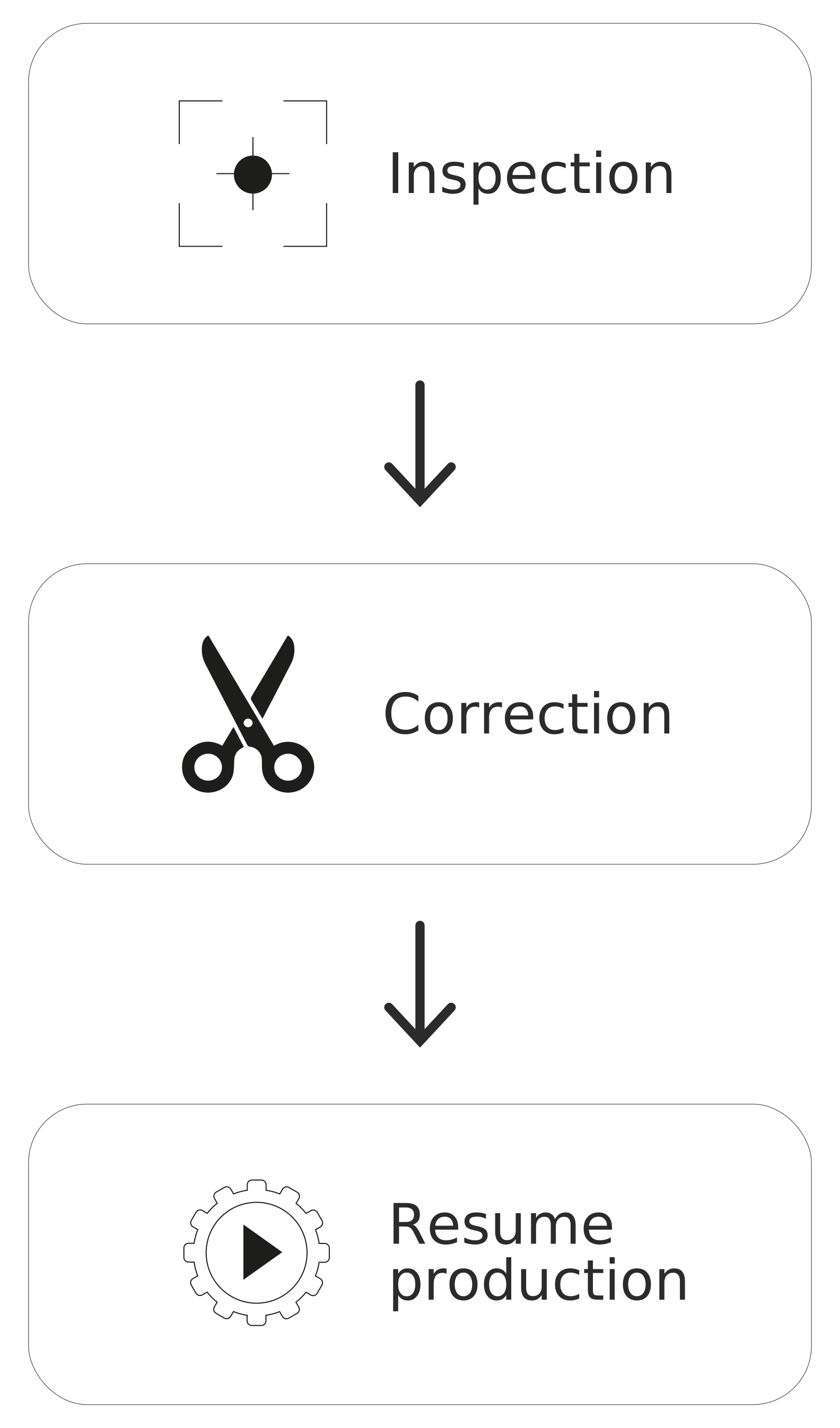
In its most common configuration, an inspection table operates according to a straightforward principle. The material passes through the system, which compares the printed product with a reference either the customer-approved PDF or a template created directly on the machine. Any anomalies are flagged to the operator.
The operator then intervenes to remove or correct the defect, presses “Start,” and production resumes.
At first glance, this sequence appears both logical and effective. However, it contains a structural limitation that is often overlooked: once the operator has completed the correction, there is no automated system that verifies with absolute certainty that the defect has been fully resolved.
Production therefore resumes based on human judgement rather than automated validation.
As a result, even when the machine successfully detects a defect, a conventional inspection table cannot certify that the problem has actually been corrected. Responsibility for the quality of the finished product ultimately rests with the operator on duty.
This limitation exists regardless of the sophistication of the inspection system or the experience of the operator. It is not a technological issue, but a matter of process architecture.

TECHNOLOGICAL LIMITATIONS
The ZERO® process, developed by Graphimecc and protected by a worldwide patent, introduces a breakthrough that redefines process architecture and sets a new benchmark for quality standards.
The initial stage of the ZERO® process is essentially the same as that of conventional inspection tables. The key difference lies in the way production errors are managed.
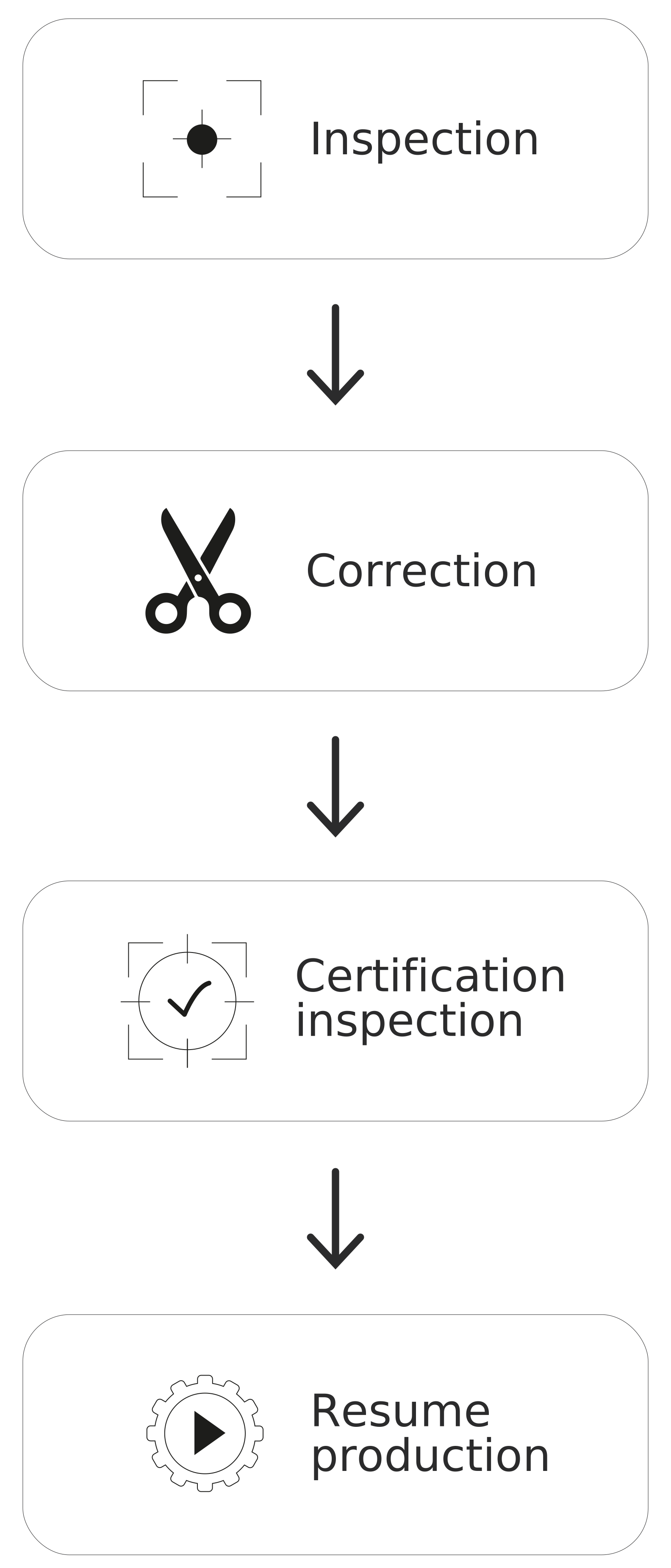
Once the operator has corrected the detected defects, a second control system automatically verifies the intervention. At this point:
This cycle continues until the automated system confirms full compliance. As a result, no defect can reach the end customer.

BENEFITS
An inspection table detects defects; ZERO® certifies that they have truly been eliminated, minimising disputes.
At the end of each job, the ZERO® process automatically generates a structured report documenting every anomaly detected, every corrective action taken, and the related automated validation. It is irrefutable proof that the product delivered perfectly matches the agreed specifications.
For the converter, this means being able to respond to any dispute with precise documentation that meets the requirements of even the most regulated, stringent and demanding sectors.
The difference between the two solutions is clear and is well illustrated in the table below.

Process
Inspection – Correction – Resume production
Quality responsibility
Assigned to the operator
Controllable elements
Print quality inspection only

Process
1st Inspection – Correction – 2nd Inspection – Validation – Resume production
Quality responsibility
Assigned to the machine
Controllable elements
Print quality – Variable data – RFID
For both solutions, several machines are available on the market to cover entry-level or high-productivity requirements.
The ZERO® process is designed to be flexible and is installed in various types of machines to raise quality standards across different application areas, including:
ZERO PQI machines are designed to certify the print quality of graphic labels or packaging against the production template or the original PDF approved by the client.
ZERO VDP machines are designed for printing and validating variable data (including grading), guaranteeing 100% finished product quality in a single production step.
ZERO RFID machines are designed for RFID encoding and inspection of RFID products of any frequency (UHF, HF, NFC, BLE), guaranteeing 100% finished product quality in a single production step.
To explore how the ZERO® process can be applied to your production environment
Quality control serves to detect any defects or non-conformities during the production process, with significant limitations as to what is actually done once an anomaly is found. Quality certification, on the other hand, adds a further level of assurance, documenting that the product has been verified against defined criteria and that any non-conformities have been identified and dealt with correctly.
Print Quality Inspection is the process of automatically verifying the quality of a printed product. Using vision systems and specific inspection criteria, it is possible to detect print defects, verify text and variable data, and inspect elements such as barcodes and 2D codes, depending on the system configuration.
Not necessarily. A control system may detect an error, but this does not automatically mean that the non-compliant product has been removed from production or that the correction has been carried out correctly. To ensure the compliance of the finished product, it is therefore important to manage non-conformities and verify that they have been properly resolved; for this reason, Graphimecc machines are specifically designed to ensure the proper management of non-compliant products (certification via the patented ZERO process).
Non-conforming product marking or reconciliation
We integrate Videojet 1280/ VJ1580+
The unit has been fully integrated into the machine control panel what enables a wide range of benefits
For the operator:
Possibility of having a single panel where every machining parameter can be configured
For net plant productivity:
Reduction of setup time and guarantee of constant and correct functioning of the unit
Non-conforming Product Marking Functionality
The machine process automatically handles the marking of non-conforming products by integrating it within the error management process chosen for production.
Functionality of printing on the back of the material
The machine process automatically manages the printing of variable data on the back of the material (liner) for each reconciliation requirement by integrating their management within the error management process chosen for production.
Ability to integrate other third-party CIJ systems
Other third-party CIJ printing systems can be integrated upon development of the command-and-control interface.
Thermal transfer printing
We integrate Videojet Dataflex 6530
The unit has been fully integrated into the machine control panel what allows a wide range of advantages
Ability to integrate other third-party TTO systems
Other third-party TTO printing systems can be integrated upon development of the command-and-control interface.
Spark Cam™
Vision inspection system
What is SPARK CAM?
SPARK CAM™ is a high-performance vision inspection system fully designed and built by our R&D department to control print quality during production.
The system reliability is also the result of more than two decades of direct market experience with some of the most popular inspection systems including: Decosystem and Lake image.
System fully integrated into the machine control panel
The system is fully integrated into the machine control panel which enables a wide range of benefits
Single system to manage the Print Ǫuality of graphics and Variable
Single system where two control macro areas can be activated with different libraries related to specific production needs:
Print Ǫuality Inspection:
Libraries for the inspection of security elements, scratches, smears, streaks, stains, ink splashes, ghost effects, torn material, creases, color deviation, …
Thanks to our vision engineering department, it is, in addition, possible to directly develop customized control features.
Print Ǫuality inspection of Variable Data:
Libraries for OCR control (with a full range of fonts/special characters), machine readable codes also with grading features according to international standards:
With a wide range of codes and encoding protocols including: ǪRcode, Data Matrix, … and with GS1 coding standards, ….
Wide range of available templates
Due to the fact that we make our inspection systems in-house, Graphimecc can meet any production requirement.
Available are:
both black-and-white or color systems, and with a wide range of resolutions to fit every inspection specification.
Spark Jet™
Inkjet printer
What is SPARK JET?
SPARK Jet™, is an inkjet printing system completely designed and built by our R&D department to go beyond the frequent limitations of traditional printing systems.
The system reliability is also the result of more than two decades of direct market experience with some of the manufacturers of the most popular inkjet printing systems such as: Domino, Videojet, REA JET.
System fully integrated into the machine control panel
The system is fully integrated into the machine control panel which enables a wide range of advantages:
High performance and print quality
SPARK JET™ offers different print resolutions depending on the production speed. Thus, you can get a high-quality product (600x600dpi) or lose definition slightly to increase production speed.
Modular print height
Each printing module has a printing height of 54mm.
The SPARK JET printing system is fully modular and can be composed to achieve the desired print height without any limitation.
Wide range of inks that can be used
SPARK JET™ can be configured to print with different base inks:
This flexibility allows adaptation to the widest range of materials, managing every production requirement.
Single-color, multi-color system
SPARK JET™ is available in two versions:
Automatic cleaning system
To maximise the durability of SPARK JET™ print heads, we have developed an automatic cleaning system that is fully managed via the machine’s central panel. This system cleans the heads every X hours of printing (with X being a parameter that can be adjusted according to the characteristics of the print and substrate) and positions them so that they rest in a way that protects them from ink drying inside the nozzles.
Furthermore, as it is fully motorised, it allows for easy and precise adjustment of the print head’s height and transverse position relative to the material.
High-precision adjustment holder
Each SPARK JET™ system is equipped, as a basic feature, with a high-precision adjustment system that, in the absence of the automatic cleaning system, allows the adjustment of the printer position both in height (distance from the substrate) and in transverse position with respect to the material.
With this option, the head cleaning and resting activities are manual.
Spark RFID™
RFID antenna and reader
What is Spark RFID?
Spark RFID™ is a system completely designed and built by our R&D department and allows to control and encode any RFID TAG (UHF, HF, NFC, BLE and RF, …), ensuring maximum reliability and efficiency.
The system reliability is also the result of continuous collaboration with chip and Inlay manufacturers such as:
Modular system that can be configured according to individual needs
Due to its modular structure SPARK RFID can be configured in different modes to allow the best productivity according to production needs and the type of RFID to be processed.
Easy encoding, even for inexperienced operators
Thanks to our fully graphical GMG RFID Memory Map™ editor, the creation of any type of encoding finally becomes intuitive and accessible to everyone.
Ǫuick and intuitive setup, even for inexperienced operators
Setting up RFID production becomes quick and accessible to every operator; thanks to the high level of automation, our machines can be operated autonomously by any finishing operator without requiring specific knowledge of electronics or telecommunications.
System fully integrated into the machine control panel
The system is fully integrated into the machine control panel allowing a wide range of advantages
100% compliant with regulatory standards

Certified CE Marking
CE marking plays an increasingly important role in protecting operators and the enterprise.
For Graphimecc this is an indispensable value.
Advanced levels of automation

Integration with external software
The machine is natively integrable either directly or with the GM ENTERPRISE™ CMS with any ERP and enterprise database ensuring secure, real-time data exchange.
Usable by any operator

Fully graphical interface
Designed to be usable by any operator regardless of experience level.

Advanced operator login
Integration with user management via corporate Active Directory for machine access in compliance with internal security policies.
To certify the quality of production

Automatic production reports
The machine generates various production reports fully automatically and with customisable content.
Automatically eliminates all production errors

ZERO™: the technology that enables you to produce a 100% error free finished
Developed since 1999, it is now in its 5th generation and is the most advanced technology for:
ZERO™ represents the next generation of quality finishing in that it allows:

ZERO™: the technology that guarantees the highest productivity
ZERO™ enables productivity levels up to 10 times higher than other solutions available on the market.

ZERO™ enables productivity levels up to 10 times higher than other solutions available on the market.
ZERO™ allows you to choose between 21 different error management processes to meet every production need.
Detects all errors with absolute precision

Inspection of Variable data
You can manage the control of any type of variable data: OCR, Linear Barcode (1D and 2D), 2D Matrix Barcodes with different encoding types (Industrial, GS1, …).

Inspection of printing defects of the graphic products
You can manage the inspection of various printing defects typically related to the graphics part such as: scratches, smudges, streaks, spots, ink splashes, ghost effects, torn material, creases, color deviation, …

Modular control features
With our fully graphical GMG Layout EditorTM, configuration of each control feature becomes intuitive and accessible to everyone.

Ability to customize the vision system to your specific needs
Machine configuration also allows you to choose the vision system best suited to your production needs:
Our specialty since 1999

Print every type of variable data
You can manage the printing of any type of variable data: OCR, Linear Barcode (1D and 2D), 2D Matrix Barcodes with different encoding types (Industrial, GS1, …).

OCR

Linear barcodes 1D

Matrix barcodes 2D

Advanced Variable Data Printing Functionality
Thanks to our fully graphical GMG Layout Editor™, creating any type of variable data printout becomes intuitive and accessible to everyone.

Ability to manage any type of protocol and sequence
Variable data printing can be configured by choosing from a wide range of fonts and codes to which sequences of all types can be linked, being able to meet every production need.
Possibility to integrate a wide range of printing systems
The machine can be configured by integrating different printing units to best meet production needs and investment budget.